

Who Actually Won Super Bowl LX
The culture, the commentary, and the capital behind America's biggest media event.


On paper, the 2026 Super Bowl was a championship game. In practice, it was something closer to a cultural referendum.
By the time kickoff arrived, the night had already moved beyond sports. Social feeds were locked onto pregame performances, group chats debated commercials in real time, and brands prepared for the single most expensive 30 seconds of advertising most would purchase all year.
What unfolded over the next several hours made something clear: the Super Bowl is no longer just where American culture gathers. It is where American culture gets negotiated.
From one muse to the next
The first signal came before the game even started.
Standing on one of the most-watched stages in the world, Coco Jones delivered a performance of Lift Every Voice and Sing. Honoring the late musical legend, Whitney Houston in an outfit inspired by her 1991 Star Spangled Banner performance, this moment felt like a generational handoff from one muse to the next.
For many viewers, the significance wasn’t just musical. It was symbolic — a continuation of a long arc of Black performance moving from cultural contribution to a cultural centerpiece. Jones didn’t frame the moment as history. She performed it as present tense.
One time for PR

By halftime, the cultural center of gravity shifted again.
Bad Bunny’s headlining performance was widely discussed before it even began, with online commentary split between anticipation and criticism. Once the show started, the framing changed. The performance unfolded less like a crossover moment and more like a declaration of arrival.
For years, industry language framed Latin music as “crossing into” the mainstream. The halftime stage suggested that framing is outdated. Spanish-language performance was not treated as translation. It was treated as default.
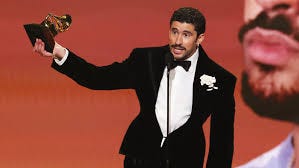
The set’s visuals — rooted in Caribbean identity, diasporic storytelling, and national symbolism — reinforced what streaming data and global touring numbers have already proven: the mainstream is multilingual, multi-ethnic, and increasingly audience-driven rather than industry defined.
By the end of halftime, the question wasn’t whether the performance was successful. It was whether the conversation around it was still using outdated definitions of who the Super Bowl is “for.”
The Real Money Makers
If the performance showed who drives culture, the commercials showed who profits from it.
The cost of entry alone remains staggering. A 30-second Super Bowl advertisement now sits in the $8-10 million range, before production, talent, music licensing, or digital distribution are factored in. For some companies, the total campaign investment surrounding a single ad can rival an entire quarter’s marketing budget.
Despite that cost, brands continue to compete for placement because the Super Bowl remains one of the last remaining moments of guaranteed mass attention. More than 100 million viewers watch live, creating a media environment where attention is not fragmented by algorithm or platform.
For advertisers, the Super Bowl functions less like an ad buy and more like a market signal — proof of relevance, stability, and cultural awareness.

One of the clearest examples of that strategy this year came from Levi’s.
Rather than centering product features, the brand leaned into cultural storytelling. The campaign — featuring a cast spanning music, sports and fashion — positioned denim not as a commodity, but as a symbol of identity and confidence.
Featuring Doechii added another layer. Her presence signaled alignment with youth culture and music credibility while reinforcing the long-standing relationship between Black cultural production and global fashion influence.
The campaign didn’t attempt to explain culture. It assumed the audience already understood it — a shift that increasingly defines successful modern advertising.
If the night illustrated anything, it is that eh Super Bowl now operates as a convergence point: entertainment, commerce, identity and politics sharing the same stage whether intentionally or not.
Public reaction to the halftime show quickly moved beyond performance critique into ideological territory, reinforcing how major cultural stages now double as political symbols.