

The Reality Check We've Been Needing: Inside America's Next Top Model
A generational reckoning with beauty, power, and reality TV

Whatever Tyra Banks did with America’s Next Top Model was iconic. But maybe… let’s not do it again.
In a recent Netflix documentary, Tyra Banks, Miss J. Alexander, Jay Manuel, Nigel Barker, and past contestants from the 24-season, early-2000s reality TV juggernaut recount their experiences for the first time.
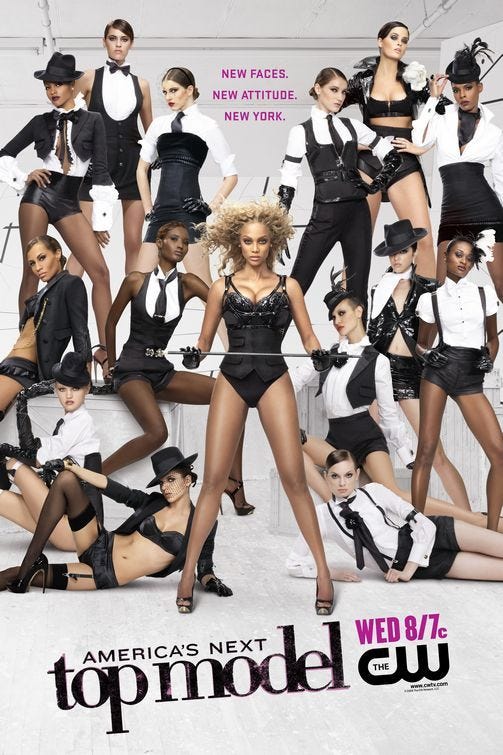
Iconic, and Still Complicated
Now, I don’t know about you—but me? I’m 5’9. I’ve been 5’9 since I was 13. So it’s safe to say I’ve been a tall girl my whole life.
Growing up, I thought that meant I had two options: play sports or model. And seeing as though I don’t have the best hand-eye coordination, I found myself drawn to the possibility of modeling.
But that idea always felt out of reach—until I discovered America’s Next Top Model. I may have binged the entire 24-season catalog in two months. I was obsessed.
Watching everyday women transform into real-life supermodels made it feel possible. Attainable, even. If there was one thing a tall, skinny girl could do, it was become America’s Next Top Model. And for a long time, I swore that one day, I would.
The Rules I Thought I Was Learning
But the lens that 24-year-old Mycah watches with in 2026 is very different from the lens 13-year-old Mycah used in 2015. Back then, I thought the show was teaching me all the hidden rules of the fashion industry early.
Don’t eat too much.
Don’t speak too loudly.
Be palatable.
Be manageable.
I mistook conditioning for preparation. What felt like insider knowledge was really a quiet lesson in how to make myself smaller—physically, emotionally, and socially—in exchange for proximity to success.
What We Called “Realism”

Many of the show’s most controversial moments weren’t received as controversial at the time. They were framed as “tough love,” “industry realism,” or simply the price of becoming a model. We didn’t question them because we weren’t taught to.
But it’s 2026, and we don’t body shame anymore. We live in a world where anyone can become a model, whether they’re a size 0 or a size 12.
What America’s Next Top Model normalized was the public policing of women’s bodies; weight checks, casual comments, and “concern” that often crossed into humiliation. At the time, it was framed as realism. Now, it reads as unnecessary harm packaged as discipline.
The show also blurred the line between transformation and consent. Makeovers were treated as tests of character, not choices, teaching viewers that discomfort was a prerequisite for success. We were trained to root for compliance.
Moments involving race and culture were similarly mishandled. What once passed as edgy or educational now looks like stereotyping in the name of entertainment. And emotional breakdowns were edited into storylines, turning distress into proof of ambition rather than a warning sign.
We didn’t question it then because we didn’t have the language. Now we do.
Growth, Even If It Was Imperfect
And still, I can’t pretend America’s Next Top Model didn’t grow. As the seasons progressed, so did the show. It expanded its definition of beauty by introducing plus-size contestants, embracing models who didn’t fit the industry’s narrow mold, and eventually making space for trans and male models in ways that felt intentional for the time. The world was changing, and imperfectly but visibly, the show changed with it.
That evolution matters. It reminds us that representation is not static. It is something that shifts as culture does, often slowly, often unevenly, but forward nonetheless.
What I Take With Me
I still have model dreams. They just don’t look like what 13-year-old me imagined. I no longer believe success requires shrinking myself to fit someone else’s standard or enduring discomfort to earn legitimacy. If I step into that world, it will be on my terms, fully formed, fully voiced, and fully aware.
America’s Next Top Model taught a generation of girls that visibility was possible. What this moment asks of us now is to imagine visibility without harm. Progress without punishment. Opportunity without erasure.
Some things were iconic.
Some things should stay in the past.
And some lessons, finally, we get to rewrite.